What is Sentinel?
Sentinel sits between raw information and human understanding. It collects open-source material, extracts structure (entities, locations, relationships, timelines), and retains provenance so analysts can verify claims instead of inheriting them.
Our default mode is evidence-first: every output links back to primary sources and makes uncertainty explicit. Sentinel is designed to augment human judgment, not replace it.
For NGOs and researchers, this means faster triage, clearer context, and a reproducible audit trail across fragmented coverage.
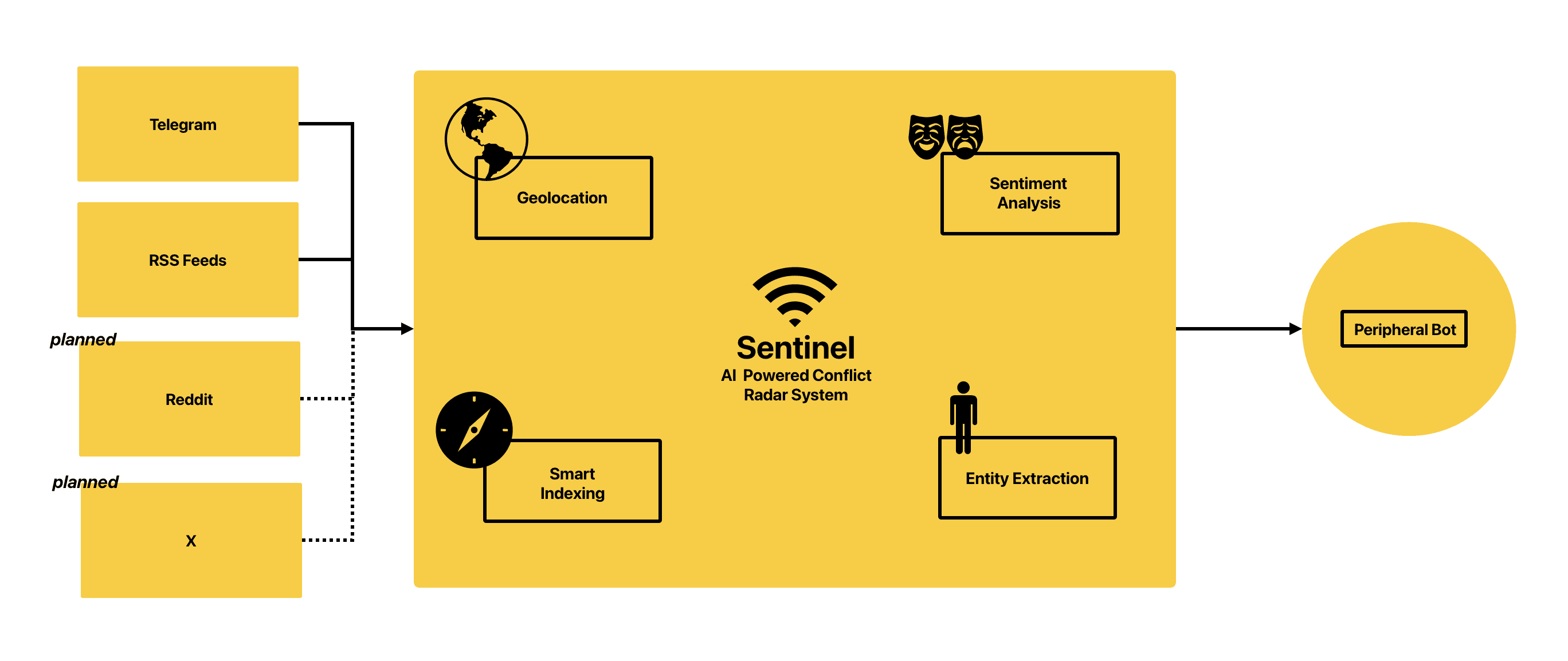
Sentinel, end to end: from raw OSINT to structured, auditable intelligence
The Principles Behind Sentinel
The Peripheral exists to keep truthful, verifiable information accessible. Sentinel is how we operationalize that mission.
Truth Above All Else
We prefer traceable evidence over persuasive narrative. The job is clarity, and the ability to hold actors accountable with verifiable records.
Open-Minded, Not Gullible
We respect the full range of human testimony, and we avoid total dependence on any single person, channel, or institution. The whole is who we serve.
Probability, Not Absolutes
True and false are rarely binary. Sentinel is built to make uncertainty explicit: confidence, corroboration, contradictions, and the remaining chance we are wrong.
Humans Remain in the Loop
Automation scales triage and pattern-finding. Humans make the final calls. Every automated output is designed to be auditable, correctable, and contestable.
Workflow: From Noise to Knowledge
Sentinel is a pipeline of transformations. Each stage produces artifacts you can inspect, reproduce, and challenge.
- 1. Collect — ingest open sources (feeds, channels, publications) with capture metadata and media attachments.
- 2. Normalize — dedupe, standardize timestamps, resolve source identity, and preserve original text/media for audit.
- 3. Enrich — extract entities, locations, and candidate signals; generate summaries as navigation aids (not ground truth).
- 4. Link — connect related items into stories and timelines using multiple signals (content similarity, entity overlap, and temporal proximity).
- 5. Deliver — expose the structured view via the website and programmatic interfaces with clear provenance.
Output
Stories
Clustered narratives backed by multiple sources, with timestamps and linked evidence.
Output
Entities
People, organizations, locations, and objects extracted as structured data for search and analysis.
Output
Signals
High-salience events and alerts for monitoring, triage, and investigative workflows.
Evidence and Auditability
In a post-truth environment, the output matters less than the audit trail. Sentinel is built so you can answer: Where did this come from? What supports it? What contradicts it?
What We Preserve
- Primary sources — direct links and source identity, not screenshots of screenshots.
- Capture metadata — when it was observed and when it was collected.
- Media context — attachments and surrounding text where available.
- Structured extraction — entities and locations that power analysis and discovery.
- Change visibility — corrections and updates are treated as first-class events, not silent edits.
Uncertainty Is a Feature
Sentinel treats truth as a probability, not a proclamation. We show confidence and corroboration so analysts can weigh evidence without being pushed into false certainty.
Confidence Scoring
Confidence reflects how strongly the available evidence supports an extraction or linkage. It is not a claim of correctness, and it is always revisable.
Contradictions and Gaps
Disagreement between sources, missing context, and low-quality evidence are surfaced as part of the analysis, not hidden behind a single summary.
Access and Integrations
We aim to democratize intelligence without dumbing it down. Access is designed to support real research workflows and preserve an audit trail.
Website
Browse structured stories, sources, and geospatial context with direct links back to primary material.
Programmatic Access
For partners, we provide programmatic access for integration into investigative and research tooling. We prioritize transparency, provenance, and rate-limited safety for dual-use concerns.
Exports
Structured exports enable reproducible analysis and reporting pipelines.
Implementation Notes (What We Share Publicly)
We believe methodology should be transparent and auditable. At the same time, operational specifics can be dual-use. Publicly, we share the shape of the system, not the full blueprint.
Infrastructure
- Incremental ingestion — continuous collection with dedupe and capture metadata.
- Structured datastore — queryable storage for stories, entities, and provenance.
- Media storage — durable storage for attachments required for verification.
- Queue-based processing — background jobs for enrichment and linking.
AI & NLP
- Extraction — entities, locations, and candidate signals from text and metadata.
- Linking — similarity + overlap heuristics to group related material into stories.
- Summarization — navigation aids with explicit auditability and correction paths.
- Uncertainty modeling — confidence, corroboration, and contradiction surfacing.
Verification
- Provenance — preserve source identity and direct URLs wherever possible.
- Reproducibility — structured outputs that can be re-queried and re-audited.
- Human correction — mechanisms to challenge and improve automated inferences.
Frontend
- Geospatial context — maps and timelines that stay linked to evidence.
- Exploration UX — fast search, filtering, and cross-linking across entities.
- Readable defaults — design optimized for understanding, not endless scrolling.
Working on Accountability Research?
If you're an NGO or researcher, tell us what you're investigating. We'll show you how Sentinel can help you move from fragmented coverage to structured, source-linked understanding.